

 See My Latest Article on HelloNation

Lumber is not one single material. Boards and structural members differ in strength, moisture content, appearance, treatment, and intended use. Choosing the right type depends on whether the project involves framing, trim, shelving, outdoor construction, repairs, or exposed finishes.
For residents working on homes and outbuildings in Macomb, local seasonal conditions also matter. Moisture, summer humidity, winter freezing, and repeated expansion and contraction can affect how wood performs over time.
What are the main categories of lumber?
The broadest distinction is between softwood and hardwood, although those names describe the tree type rather than the actual hardness of every board.
Softwood lumber generally comes from evergreen trees such as pine, spruce, and fir. It is widely used for:
- Wall, floor, and roof framing
- Studs, joists, rafters, and trusses
- Fences and general construction
- Shelving, workbenches, and utility projects
Softwoods are usually lighter, easier to cut, and more widely available in common construction dimensions.
Hardwood lumber comes from broadleaf trees such as oak, maple, ash, and poplar. It is often selected for:
- Cabinets and furniture
- Stair parts and handrails
- Interior trim and doors
- Durable surfaces and decorative projects
Hardwoods can be denser and more resistant to wear, but they may also cost more and require sharper tools or different fastening methods.
The category alone does not determine suitability. A treated softwood board may be a better choice for outdoor use than an untreated hardwood, while a clear hardwood may be preferable for visible interior trim.
What is dimensional lumber?
Dimensional lumber is sawn and surfaced to standardized sizes. The dimensions printed on a board are usually its nominal size, not its actual measured size.
For example, a board sold as a 2-by-4 is typically smaller than two inches by four inches after drying and surfacing. This difference matters when calculating framing layouts, shelf spacing, stair parts, or replacement pieces.
Common dimensional lumber includes:
- 2-by-4 and 2-by-6 boards for wall framing
- 2-by-8, 2-by-10, and 2-by-12 boards for joists, headers, beams, and shelving
- 4-by-4 and larger posts for supports and outdoor structures
Dimensional lumber may be graded for strength, appearance, or both. A board intended for structural framing should not be substituted casually with a lower-grade board that only looks similar.
What do lumber grades mean?
Lumber grades describe characteristics such as knots, splits, wane, straightness, and strength. The grading system depends on the species and whether the board is intended for structural or appearance use.
For framing lumber, common descriptions include grades related to structural strength and visual defects. Higher structural grades generally contain fewer weaknesses and are more appropriate for demanding spans or load-bearing applications.
Appearance boards are often graded according to how clean and uniform they look. A board with small knots may be perfectly suitable for a rustic shelf but less appropriate for painted trim where a smooth, consistent surface is expected.
A practical rule is to match the grade to the job:
- Use structural-grade lumber for framing and load-bearing components.
- Use appearance-grade lumber for trim, furniture, and visible finish work.
- Avoid selecting boards only by price if the piece will carry weight or resist movement.
What is treated lumber, and where should it be used?
Pressure-treated lumber has been infused with preservatives to resist decay, insects, and moisture-related deterioration. It is commonly used where wood will be exposed to soil, rain, or frequent dampness.
Typical uses include:
- Deck framing and outdoor stairs
- Fence posts
- Ground-contact supports
- Raised garden structures
- Exterior ramps and platforms
Treated lumber is not waterproof. It can still absorb moisture, crack, warp, and develop surface checking. Freshly treated boards may also be noticeably damp and heavier than untreated lumber. Allowing them to dry before installing certain finish materials can improve fit and reduce movement.
Fasteners and connectors used with treated lumber should be rated for treated-wood applications. Ordinary fasteners may corrode prematurely, especially in damp outdoor conditions.
What is kiln-dried lumber?
Kiln-dried lumber has been placed in a controlled heated environment to reduce moisture content. Most interior framing lumber is kiln-dried because drier wood is generally more stable than freshly sawn or green lumber.
Lower moisture content helps reduce:
- Shrinkage after installation
- Twisting and cupping
- Gaps around joints
- Changes in wall and ceiling dimensions
Even kiln-dried wood can take on moisture if stored outdoors or exposed to rain. Before indoor installation, boards should be kept protected and allowed to adjust to the conditions of the space when practical.
This is especially useful during seasonal projects. Wood installed during a humid summer may behave differently after indoor heating begins in winter.
How do plywood, OSB, and solid boards differ?
Not all lumber products are solid boards. Engineered wood panels are made by bonding layers, strands, or veneers into sheets.
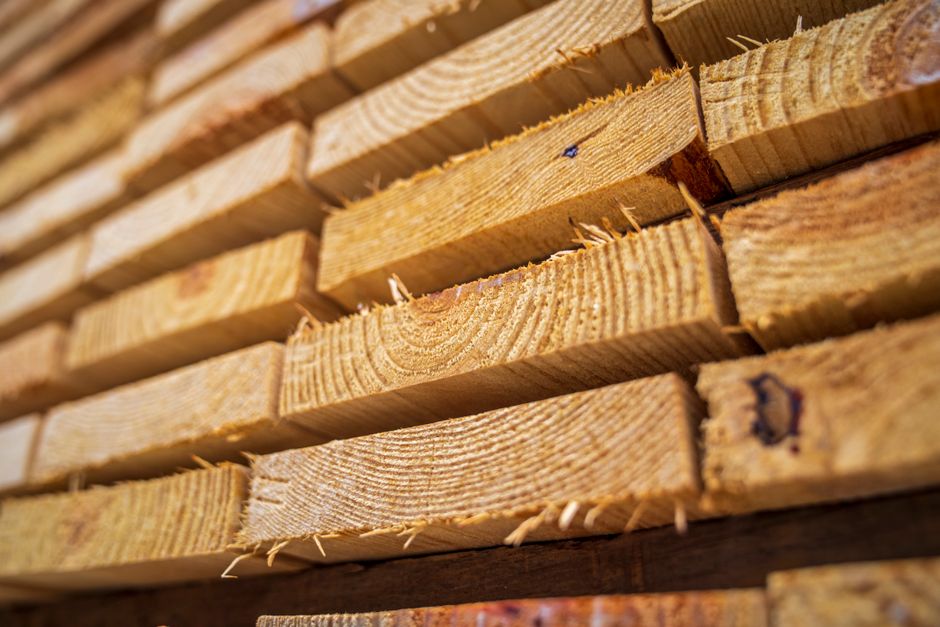
Plywood is constructed from thin wood layers arranged in alternating directions. It is valued for strength, dimensional stability, and resistance to splitting. It is commonly used for:
- Roof and wall sheathing
- Subfloors
- Cabinets
- Shelving and work surfaces
Oriented strand board, often called OSB, is made from compressed wood strands bonded with adhesive. It is widely used for structural sheathing and subfloor applications. Its performance depends on the specific grade and exposure rating.
Solid-sawn boards are cut directly from logs. They are useful for trim, blocking, shelving, furniture, and many repair projects, but they can move more noticeably with changes in moisture.
Panels should be chosen by thickness, span, exposure rating, and structural purpose rather than appearance alone.
Which lumber is best for indoor projects?
For indoor framing, standard kiln-dried softwood is commonly used. For visible work, the choice depends on the desired finish and level of wear.
Pine is often easy to work with and suitable for painted or casual projects. Poplar is frequently chosen for painted trim because it can provide a relatively smooth surface. Oak and maple are harder, more wear-resistant options for furniture, flooring details, and high-contact surfaces.
Before buying boards for interior work, inspect them for:
- Bowing, cupping, twisting, or excessive warping
- Large loose knots
- Splits at the ends
- Rough or damaged edges
- Uneven thickness
- Moisture staining or mold-like discoloration
A slightly imperfect board may still work for blocking or short cuts, while long visible pieces usually require more careful selection.
Which lumber is best for outdoor projects?
Outdoor lumber should be selected based on exposure. Boards that will remain above ground and receive occasional rain may have different requirements from posts placed directly in soil.
For exterior work, consider:
- Whether the piece will touch soil
- How quickly water can drain away
- Whether the wood will be shaded or exposed to sun
- The type of fasteners and connectors required
- Whether the finished surface will be painted or sealed
Good design also protects lumber. Keeping end grain away from standing water, providing drainage, and avoiding trapped moisture can extend service life. In a climate with freezing winters and humid summers, water that enters cracks or end grain can contribute to repeated swelling, shrinking, and splitting.
What common mistakes should be avoided?
Several lumber problems begin before construction starts.
Do not assume a board is straight because one face looks acceptable. Check the full length for bow, edge curvature, and twist. Do not install visibly wet or damaged wood in a location where movement could affect doors, flooring, siding, or structural alignment.
Avoid using untreated lumber in locations that require decay resistance. Also avoid using treated lumber for interior applications where the preservatives, moisture content, or rough surface would be unsuitable.
Finally, store lumber off the ground, supported at multiple points, and protected from direct weather while allowing reasonable air movement. Proper storage can be just as important as the original lumber selection.
How should lumber be selected for a specific project?
Start with the function of the piece: structural support, weather exposure, appearance, wear resistance, or temporary utility. Then choose the species, grade, treatment, thickness, and moisture condition that match that function.
For a small repair, the correct replacement may need to match more than the visible width. Thickness, grade, treatment, grain direction, and fastening method can all affect performance. For load-bearing work, spans and connections should follow applicable building requirements rather than relying on visual judgment alone.
Understanding these differences makes lumber easier to compare and helps prevent common problems such as premature decay, excessive warping, weak framing, and mismatched repairs.